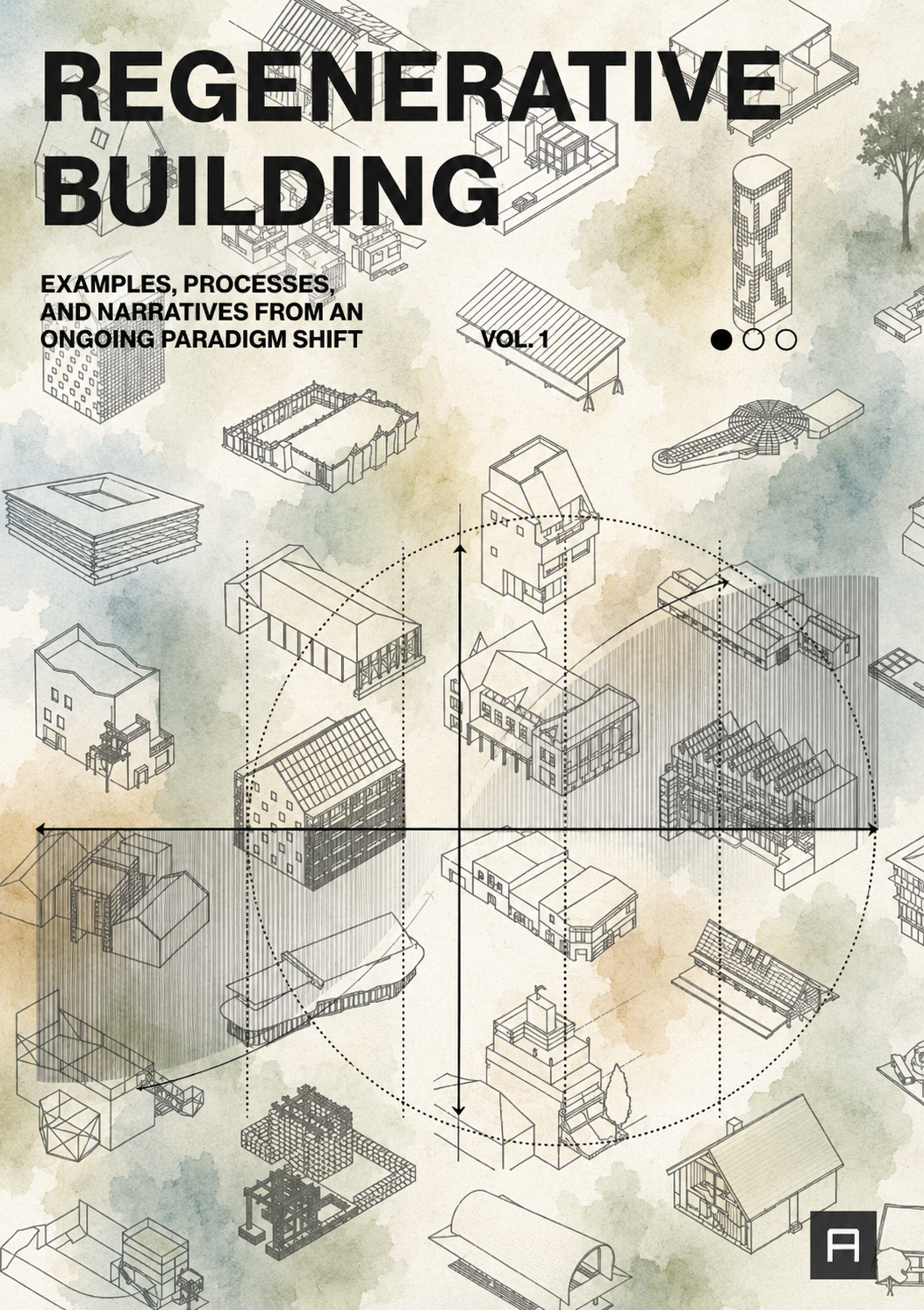
Regenerative Building: Examples, Processes, and Narratives from an Ongoing Paradigm Shift
The first in a three-part series, this report provides a literature review of the term 'regenerative building' and its core principles. It explores methods for quantifying regenerative approaches and presents a long-list of over 50 innovative international projects.
Key findings
- 01Regenerative design demands a shift from a mechanistic, harm-reduction mindset to an ecological worldview focused on co-evolution with nature.
- 02Effective practice is place-based, working with nested living systems (site, community, bioregion) to realize a location's unique potential.
- 03Barriers to adoption include policy misalignment, professional knowledge gaps, and economic models that don't account for long-term socio-ecological value.
- 04A long-list of 50+ projects showcases innovations in material reuse, community-led design, carbon reduction, and bioregional construction.
For
Architects, planners, developers, engineers, and researchers in the built environment.
The full piece
The current trajectory of the built environment is not enough; a new approach is needed that does not merely do ‘less bad’ but actively does ‘good’. This report, the first in a three-part series from the Aarhus School of Architecture, provides a research-grounded understanding of regenerative building, connecting emerging international ideas with the realities of architectural practice. It seeks to define what regenerative building entails, what processes enable it, and how it can be incorporated into current regulatory and industrial frameworks.
The publication begins with a thorough literature review, tracing the development of regenerative thinking from its roots in systems theory and ecology. It carefully distinguishes the concept from sustainability, emphasizing a shift from a mechanistic worldview to one of co-evolution with living systems. The report also reflects on the challenge of quantifying regenerative approaches, moving beyond standard Life Cycle Assessments to consider systemic impacts and biodiversity.
Executive summary
This report serves as a foundational text on regenerative building, arguing for a paradigm shift away from merely reducing environmental harm towards actively improving socio-ecological systems. It synthesizes decades of theoretical work—from early ecological thinking to contemporary systems theory—to define regenerative design as a process-oriented practice grounded in place. The authors frame regeneration not as a checklist of features, but as a relational practice that builds the capacity of people, communities, and ecosystems to evolve and thrive together.
The second half of the report presents a long-list of over 50 innovative projects that demonstrate regenerative principles in practice. These international case studies are categorized thematically, covering approaches such as the use of grown materials, community-led development, designing for scarcity, and adaptive reuse. These examples serve not as a prescriptive manual, but as a catalogue of inspiration, illustrating the diverse ways that architecture can participate in the regeneration of living systems.
A building cannot be regenerative, since it cannot self-organize, evolve, and reproduce. However, it can generate opportunities for the regeneration of the living system of which it is a part (people, habitat, soil, etc.).
Key findings
- Regenerative design moves beyond sustainability’s goal of ‘doing less harm’ to actively ‘doing good’. It is a co-evolutionary partnership with nature that aims to increase the vitality and viability of socio-ecological systems.
- The practice is defined by three core, interconnected values: an ecological worldview that sees humans as participants in nature, a systems-thinking approach that focuses on relationships, and a deep, contextual knowledge of place.
- The report identifies seven key principles of regenerative development, including working with whole, nested systems; designing from the unique potential of a place; building reciprocal relationships; and focusing on iterative, developmental processes over fixed outcomes.
- Significant barriers to adoption exist, including the dominance of a mechanistic worldview, fragmented knowledge silos, a lack of professionals skilled in ecological literacy, and rigid governance structures that hinder place-based innovation.
- A diverse range of built projects already demonstrate regenerative principles, offering tangible examples of circular material flows, community stewardship, low-carbon construction, and bioregional design.
Implications
The shift to regenerative practice requires more than technical innovation; it demands profound cultural, educational, and political transformation. Professional education must evolve to include systems thinking, ecological literacy, and interdisciplinary collaboration to build the necessary capacity for designers. At the same time, governance frameworks need to move away from prescriptive, checklist-based codes toward performance-based and place-responsive criteria that enable, rather than hinder, the context-specific solutions that regenerative design requires.
Continue exploring
More from the library
 Report
Circularity
Doughnut for Urban Development: A Manual
This manual translates Kate Raworth's Doughnut Economics into a practical framework for the building industry to use in urban development and construction projects. The Danish Built Environment played a pivotal role in co-developing this approach and publishing the manual. The Doughnut for Urban Development - A Manual is published by the Danish Architectural Press with support from Realdania and is freely available for digital access both in english and a danish version.
Circularity
Co-making and Prototyping Community Housing Futures
How a coastal UK town is bypassing global supply chains to build affordable homes using local timber, hemp, and 'automation-in-place'.