REGEN: Applied Science for a Regenerative Built Environment
REGEN is a Danish industrial research program focused on transforming the built environment through applied science. It bridges the gap between scientific theory and industry practice by embedding researchers into companies to develop regenerative pathways.
Key findings
- 01Embeds Industrial PhDs and postdocs directly within companies to ensure research is relevant to real-world technical and economic constraints.
- 02Uses the 'Doughnut for Urban Development' and 'Reduction Roadmap' as primary frameworks for systemic planetary and social health.
- 03Focuses on four key pillars: impact measurement beyond carbon, place-based regenerative design, scaling biogenic materials, and business model innovation.
- 04Aims to de-risk sustainable choices by standardizing biogenic construction and developing procurement tools for municipal clients.
- 05Operates as a three-layer learning network connecting a core research community, industry practitioners, and a long-term alumni network.
For
Architects, urban planners, policy makers, construction firms, academic researchers, sustainability consultants
The full piece
REGEN is a Danish cross-sector industrial research program focused on transforming the built environment through applied science. Facilitated by BLOXHUB and funded by Innovation Fund Denmark and Realdania, the program addresses the urgent need for a systemic retrofit of the construction sector, which is currently hindered by low margins, fragmented value chains, and short-term investment horizons.
The program uses the Doughnut for Urban Development and the Reduction Roadmap as its guidance, aiming to move beyond carbon-neutrality toward regenerative practices that promote human flourishing and planetary health.
A Systemic Learning Network
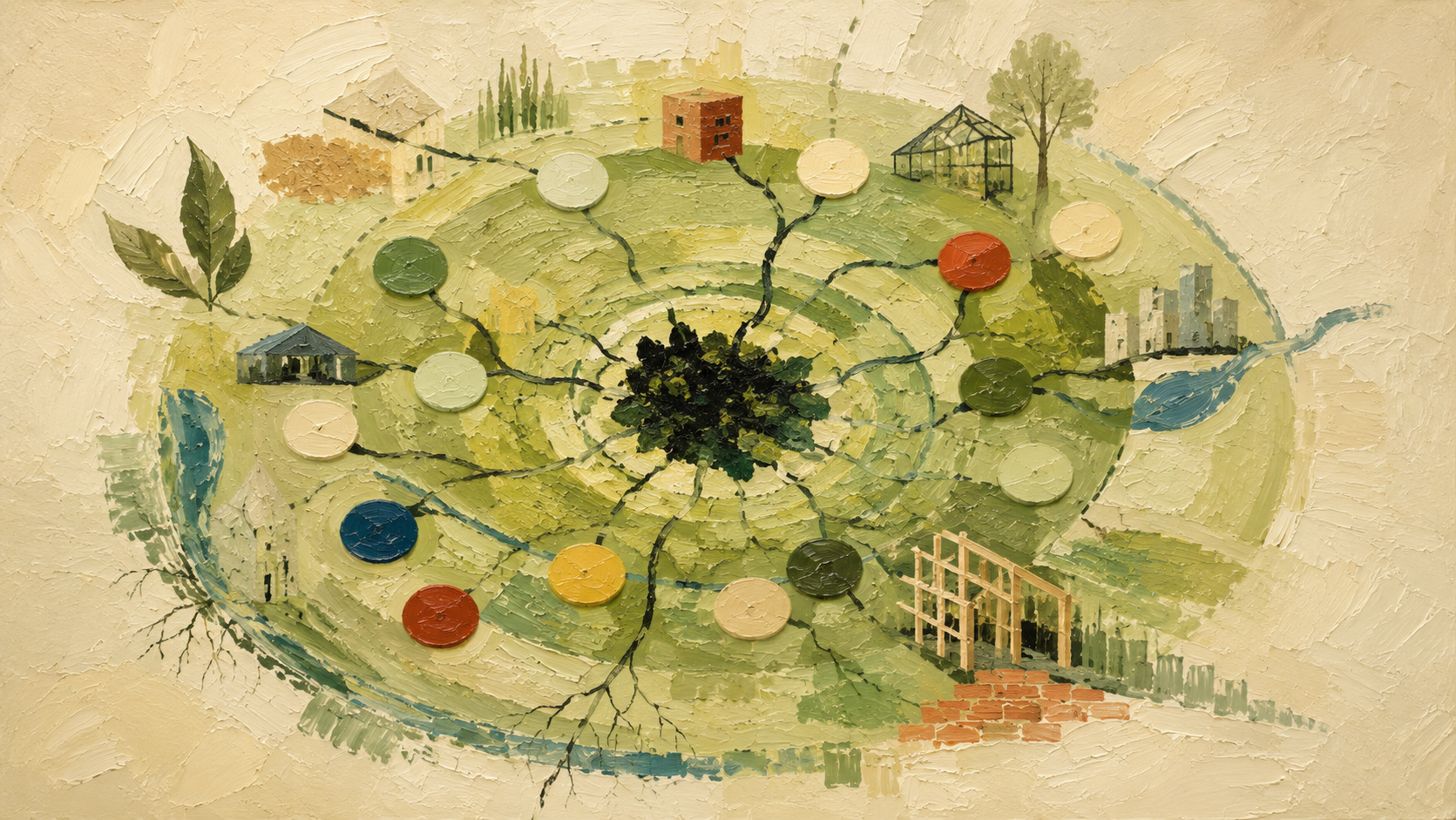
REGEN functions as a bridge between scientific insight and industrial practice by embedding Industrial PhDs and postdocs within companies. The program is structured into three layers:
Layer 1: Core Research Community:** Focused on deep knowledge, cross-disciplinary dialogues, and conceptual development among researchers.
Layer 2: Bridge to Practice:** Translating research into innovation tools for companies and driving organizational change through site visits and co-hosted activities.
Layer 3: Long-term Community:** An alumni and early-career network for ongoing scientific exchange and project development.
Key Areas of Impact The program focuses on turning unknown impacts into evidence-based decision-making tools through four primary pillars:
-
Visibility and Accountability:** Measuring biodiversity and ecosystem impacts beyond carbon, utilizing life-cycle and supply-chain tracing.
-
Regenerative Design and Planning:** Translating theoretical concepts into place-based strategies, including regenerative landscape frameworks and community co-design.
-
Biogenic Construction:** De-risking and scaling biogenic materials, standardizing circular refurbishment platforms, and demonstrating "design for disassembly" in industrialized construction.
-
Governance and Business Models:** Innovating procurement tools and economic logic to incentivize "retrofit-first" strategies, absolute sustainability targets, and space sufficiency.
By addressing the technical, organizational, and regulatory constraints of the current system, REGEN aims to make regenerative choices the default for the built environment.